Showing posts with label Frigate Bird. Show all posts

17 February, 2017

In Darwin Bay on Genovesa...


In yet another tribute to Christopher Columbus, Genovesa Island is named after his home town. Of course, the English had their own name, Tower, after a navy admiral. Genovesa is the only island on this expedition north of the equator (a full 19') thus giving the Galapagos penguins here the distinction of being the only ones in the wild in the northern hemisphere. The island is a partially collapsed volcanic caldera now open to the ocean.
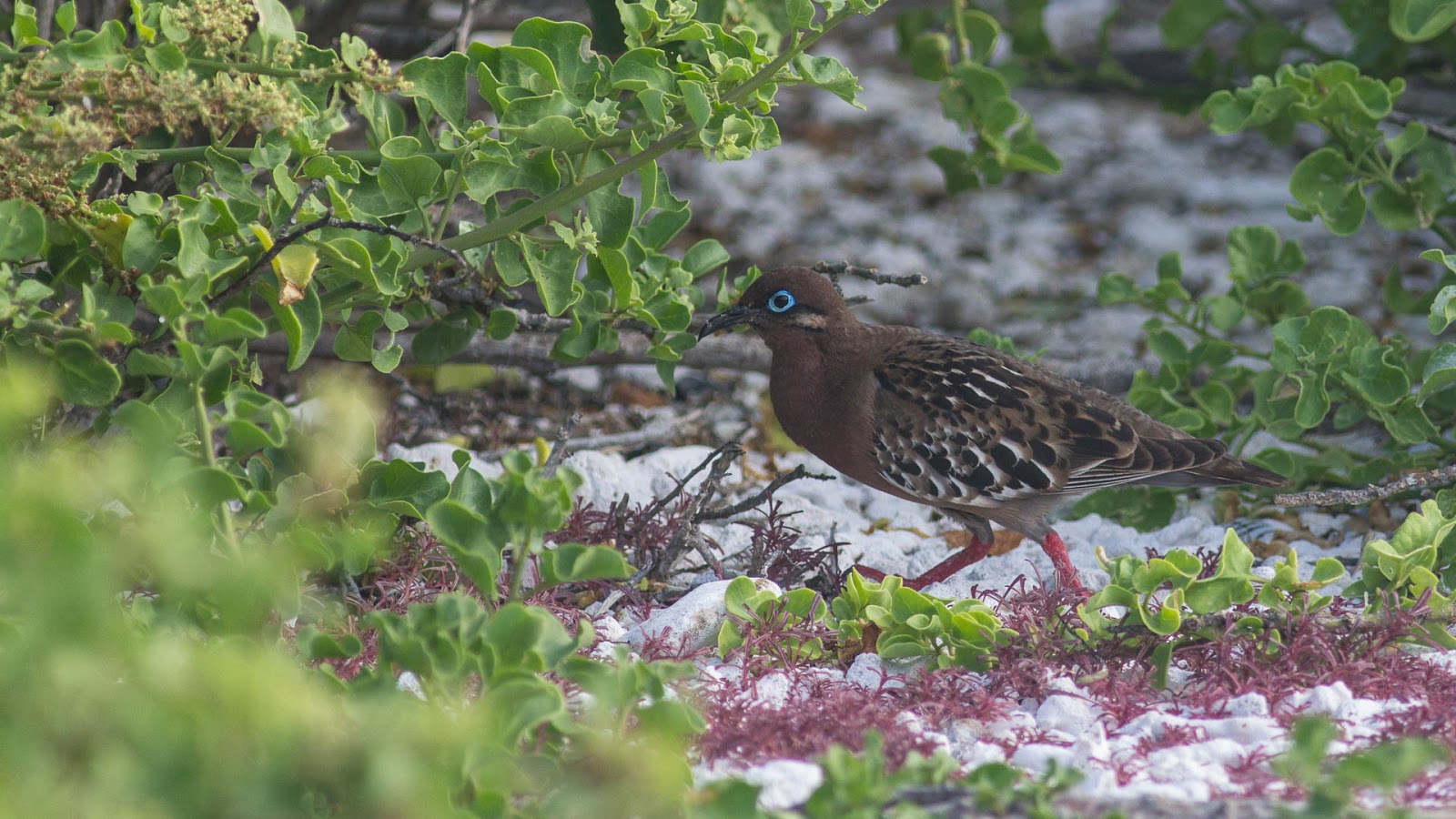
We found endemic Galapagos doves on many islands.


And endemic Galapagos mocking-birds too.


And it wouldn't be a Galapagos beach without some sea lions.


The Endeavour II anchored in Darwin Bay, and we experienced two quite special on-shore activities during the course of the day, a beach on Darwin Bay, and the Prince Philip Steps trail. Each visit was limited to about 50 people by the Galapagos National Park.

Frigate birds abound on Genovesa, this female possibly choosing a mate.


This male great (or magnificent?) frigate birds, turns his head way back in an effort to maximise the red display and attract females swooping above.


For the former, we really just roamed about a beach but it contained abundant wildlife - sea lions of course, frigate birds, blue-eyed Galapagos doves, Galapagos mocking birds, but the highlight was our first sighting of the red-footed booby. This completes our booby trifecta, Nazca, blue-footed and now red-footed. What took us by surprise was the blue bill of the red-footed booby!

Much less prolific than the Nazcar booby is this red-footed booby, a brown morph of the species, we are told.


The blue bill is a surprising characteristic of the red footed boobies.


Strking red eyes of the swallow tailed gull.


If he's waiting for the light to change, it's going to be a while!


A Nazca booby chick in the bushes.


Nazca boobies fly in formation when they are young.


Paddle boards being towed back to Endeavour II after we all fell in the water.


Swimming off the back of Endeavour II was not encouraged, but the crew still kept a lookout.


The Prince Philip Steps featured a steep staircase carved into an escarpment which gave access to an elevated plateau which surrounds much of Darwin Bay. Up here was a hot unfriendly track over fissured lava where we saw more Nazca boobys (with eggs and chicks), more red-footed boobys, and a solitary short-eared hunting owl hiding in a cave. Antonio knew exactly where to find this fellow, so we suppose he's pretty predictable.

In a dark cave on the rocky plateau at the top of the Prince Philip Steps hides this Galapagos morph of the short eared owl, the only one we saw, but Antonio knew where to look.


Everywhere on the Galapagos is a photographer's paradise.


Just hatched Nazca chick. The younger one, yet to hatch, will not survive.


The Prince Philip Steps were presumably carved for him, not by him!


As our Zodiac arrived at the landing to the Steps, we saw a fishing boat take a large albacore tuna. The fishermen looked most unprofessional, and the capture was upsettingly inhumane. Antonio said the tuna would earn $300. Some in the Zodiac wanted the fishermen reported (our video chronicler had the evidence) but our guides seemed to be conflicted over whether the catch was illegal or not.

The mother ship of these fisherman caught a large albacore tuna in our sight, but our guides couldn't agree on whether it was legal in this spot.


Local guide Antonio adding an interview to the expedition's video record.


A guest (very sharp eyed ornithologist) plus Mark (L-NG video chronicler) and Aaron (L-NG naturalist and photo instructor).


This map (credit Wikipedia) shows the two walks we did on Genovesa.

31 January, 2017

The Panama Coast...

Isla Bona
Isla Bona is a small unihabited island in the Golfo de Panama due south of Panama City , near the island of Otoque. Bona has huge bird colonies which its larger neighbour lacks, because a fishing village there has introduced domestic predators such as dogs, cats and rats.

From DIBs launched frtom the stern of Sea Lion, we were able to get close to Bona where we saw close-up brown pelicans, magnificent frigate birds and blue footed boobies in great numbers, plus quite a number of crabs! Conditions were very windy and quite rough, but we managed to keep our cameras fairly dry if not ourselves. Eric, our DIB pilot, skillfully manoeuvred the DIB to give us good close up views allowing naturalist Margrit to give excellent commentary. It was an excellent if wind-blown and splashy outing, and some nice photos follow.

Brown Booby.


Cheerful bunch of fellow expeditioners in their DIB.


Female magnificent frigatebird.


Male magnificent frigatebird.


Great interest in this fishing boat.


Here's where we clamber up onto the Sea Lion from the DIBs.

Isla Iguana
Weather was perfect as we headed just west of south to cross the Golfo de Panama, so we could round the Peninsula de Azuero and head west towards Costa Rica. Many passengers took the opportunity to read and sunbake. Dolphins enjoyed this long journey too, and we saw many chasing the Sea Lion and surfing in its bow wave.

Isla Iguana is a tiny island on the way, only a spot on the map, and we stopped there for an afternoon's R&R. The Sea Lion can only visit here a high tide. Windy and rough, there was a lot of spray and a wet landing, but luckily we were all equipped for swimming, so no harm done.

There is a very pleasant, sandy beach (with lots of tiny hermit crabs scampering around) where we swam, and a small reef 100m offshore to practice our snorkelling. The swimming was delightful on this hot day, the snorkelling was hampered by not very clear water and not many fish either. Everyone learned how to use their gear though.

Lindblad probably get into trouble if they lose anyone, so they enforce strong safety precautions on the beach. Whenever anyone is in the water, there is a lifeguard waist deep, and there's a safety DIB on duty patrolling the snorkellers.

Washed up on Isla Iguana.


What made this location fascinating was the hundreds of magnificent frigate birds swirling overhead, taking advantage of the strong breeze. The ship's doctor, who doubles as a resident orntithologist, tried to count the birds aloft, reckoning on about 500. There is a rookery behind the dunes.
Coiba National Park
After an overnight passage, we called into Coiba National Park. This is newly declared, and the only bigger marine national parks are the Great Barrier Reef Park and Galapagos National Park. Lindblad need a permit to visit here.

Some little boat had beaten us to our intended morning destination, so we scuttled off to Rancheria Beach for the morning. This proved to be an idyllic location, we swam, kayaked and stand-up paddle boarded.

Taking to the stand-up paddle board like a pro, at Isla Rancheria.


View of the white Isla Rancheria beach from a kayak.


Chilling out at Isla Rancheria.


Boats on the beach.


In the afternoon we scooted (maybe 2km) to a tiny island, Granito de Oro, a little grain of gold. It lived up to its name. The snorkelling here was fabulous, indeed its website claims Granito to be one of the 10 best dive sites in the world. Regardless, the water was crystal clear, the fish were varied, and it was maybe 2-3m deep. We were able to snorked right around the little island.

Hundreds of Panamic Sergeant Majors at Granito de Oro.


Bicolor Parrotfish.


Unknown fish species at Granito de Oro.


Moorish Idol.


Coming bcak from Granito de Oro. Later, that sand seemed to be completely underwater.